You’ve seen the scary number. 93% of searches now end without a click. It’s in every article on this topic, usually near the top, usually without the one piece of context that changes what it means.
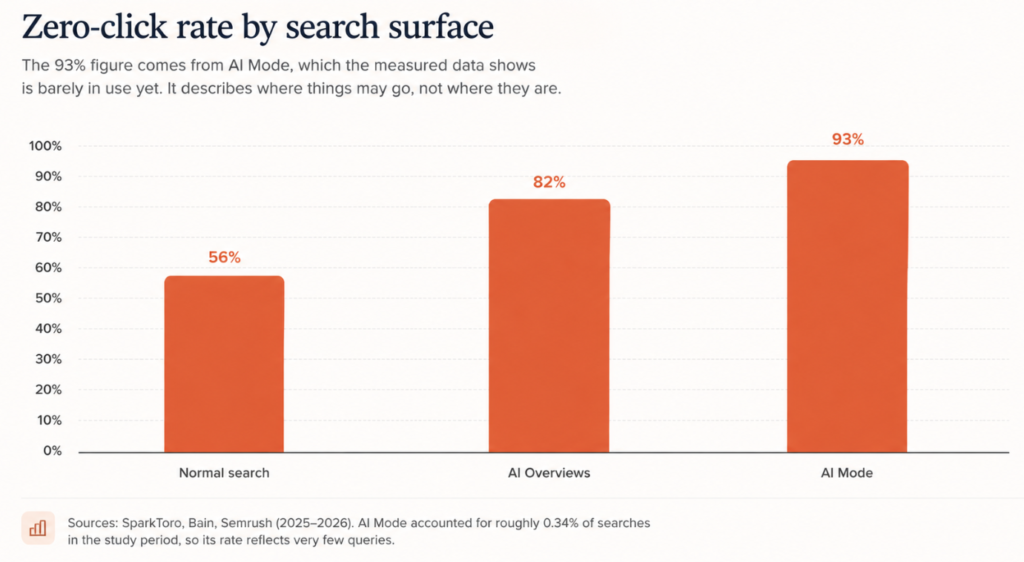
That 93% is the zero-click rate inside Google’s AI Mode, a full conversational search interface. And AI Mode, according to SparkToro’s clickstream data, accounted for around 0.34% of searches during their study period. So the most-quoted figure in this whole conversation describes a feature almost nobody was using yet.
That doesn’t mean nothing is happening. Something big is. But you can’t plan around a shift you’ve been scared into misreading, so this article separates what’s already hurting brands from what’s still mostly a projection, and what to actually do about each.
The Three Things People Mix Up
Most of the confusion comes from treating three separate things as one. They’re not, and they’re at very different stages.
| Thing | What it is | How widespread |
|---|---|---|
| AI Overviews | The AI summary box on top of normal results | Very. Around half of all queries |
| AI Mode | A separate, full chat interface that replaces results | Still tiny in the measured data |
| Gemini app | Google’s standalone chatbot, not search at all | Separate product, separate behaviour |
When an article quotes a terrifying number without saying which of these it came from, that’s your signal to be careful. The 83% zero-click figure is AI Overviews. The 93% is AI Mode. Those describe different realities, and only one of them is your reality today.
What’s Actually Happening Right Now
Set the projections aside and look at what the data already shows, because this part is real and it’s enough to plan around.
AI Overviews now appear on a large share of searches, and by late 2025 Ahrefs found they showed on the overwhelming majority of informational queries. When one appears, clicks to traditional results roughly halve. Pew Research, measuring real browsing behaviour across tens of thousands of searches, found people clicked a normal result about 8% of the time when an AI Overview was present, against about 15% when it wasn’t.
The knock-on effect is visible in traffic. Independent studies through 2025 and 2026 put organic click-through declines somewhere between a third and a half, depending on how they measured. The exact figure is disputed. The direction isn’t. Every study found a fall.
And it reaches beyond the queries that trigger an overview. Seer Interactive found click-through rates dropping even on queries that didn’t show one, which suggests the behaviour itself is changing. People are getting used to not clicking.
That last point is the one that matters, and it’s why this isn’t a passing storm to wait out.
Not Every Page Is in Danger
Here’s the distinction that the panic pieces flatten, and it decides whether you should be worried or not.
Zero-click behaviour is wildly uneven by search intent. Semrush’s intent data put informational queries at roughly 74% zero-click, and transactional queries at around 31%. That’s not a small gap. It’s the difference between two completely different outcomes.
| The query | Example | Exposure |
|---|---|---|
| Informational | “what is a cdn” | High risk. AI answers it in the box. |
| Commercial research | “best cdn for wordpress” | Mixed. People still compare and click. |
| Transactional | “cloudflare pro pricing” | Lower risk. Intent to act needs a destination. |
| Navigational | “cloudflare login” | Barely affected. They want your site. |
The pages bleeding traffic are the ones answering questions a two-sentence AI summary can fully satisfy. Definitions, quick how-tos, simple facts. If most of your traffic comes from “what is” and “how to” articles, you are directly in the path of this, and pretending otherwise helps nobody.
The pages holding up are the ones where a summary isn’t enough: where someone needs to compare, decide, buy, or reach a specific destination. If that’s what your site does, you’re more insulated than the headlines suggest.
Being Cited Is the New Being Ranked
The goalpost has moved, and this is the shift your strategy has to absorb.
For years the target was position one. In an AI answer, there is no position one in the old sense. There’s the answer, and there are the handful of sources the answer cites. Getting cited in that box is the new visibility, even when it doesn’t produce a click, because your brand name still appears in front of the person who asked.
There’s an uncomfortable finding here worth knowing. SE Ranking found that in AI Mode, only a small share of cited URLs actually rank in Google’s top 10. In other words, the sources AI picks aren’t simply the pages that already rank. Ranking well helps, but it doesn’t guarantee you’re the one quoted, and sometimes pages you’d never expect get cited instead.
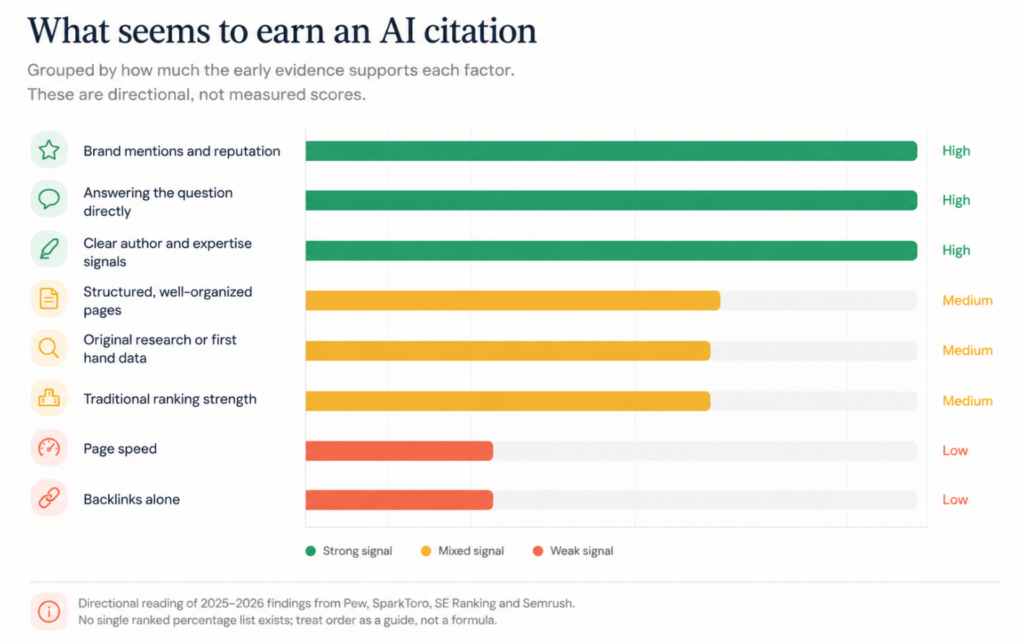
Nobody fully understands how the citation choice is made yet, and anyone claiming a reliable formula is guessing. What the early evidence points to is unglamorous: clear, well-structured pages that answer a specific question directly, from a source that looks trustworthy, get quoted more than vague ones. Which is, awkwardly, the same thing good content always was.
What Actually Helps
Cutting through the advice inflation, here’s what has evidence or sound reasoning behind it, and what’s just noise.
Answer the question directly, near the top. Pages that state the answer plainly and early are easier for an AI to lift and cite. Burying it under 600 words of preamble doesn’t just annoy readers, it makes you harder to quote.
Build genuine expertise signals. A real author with real credentials, an about page that names a person, sources you can point to. This was already the direction of Google’s guidance, and it maps onto what gets cited.
Go deeper than a summary can. If a two-line AI answer fully replaces your page, your page was always replaceable. Original testing, real numbers, first-hand experience, a genuine opinion, these are the things a summary can’t reproduce, and they’re what makes someone click through anyway.
Shift toward intent that survives. Weight your effort toward commercial and transactional pages that hold up, rather than pouring everything into definitional content the AI now eats.
Stop depending on one channel. The blog as a pure organic-traffic machine is a weakening model. Email lists, direct audiences, communities, anywhere you reach people without a search engine deciding whether they see you, are worth more than they were two years ago.
What doesn’t help: chasing rumoured tricks to force your way into AI answers, or paying for a tool that promises “AI Overview optimisation” as if it were a solved dial you can turn. Nobody has that dial. Be sceptical of anyone selling one.
Measuring When Clicks Aren’t the Point
One quiet consequence catches people out: if you only measure sessions, this looks like pure loss, and you’ll make bad decisions off that reading.
When an AI Overview answers the casual browsers and only the serious ones click through, your traffic drops but the visitors who remain are more qualified. Several practitioners report the clicks that survive an AI summary convert better, because the person arriving has already been filtered. Fewer visits, higher intent per visit.
So watch what happens after the click, not just the click count. If sessions fell 20% but conversions held, you didn’t lose, you shed tyre-kickers. Judging that page purely on traffic would tell you to fix something that isn’t broken.
Brand visibility inside AI answers is the harder thing to measure, because a citation with no click leaves no trace in your analytics. Tracking whether your brand gets mentioned in AI Overviews for your key topics is becoming its own discipline, and the tools for it are young and imperfect. Worth watching, not yet worth betting the strategy on.
If You’re a Small Site
A word for the situation many readers here are actually in, because most coverage is written for big brands with budgets.
If you’re building a blog for organic traffic right now, you’re doing it while the model is under real pressure. That’s the honest picture, and no article promising ten easy tricks changes it. Informational blog traffic is exactly the category being absorbed hardest.
That’s not a reason to stop. It’s a reason to build differently from the people who started five years ago. Don’t put everything into “what is” articles that an AI box now answers for free. Aim at questions that need depth, decisions and comparisons. Capture an audience you own, through email or a community, rather than renting all of it from Google. And treat search as one channel among several rather than the whole business.
Small sites have one real advantage here. You can move fast and you can be genuinely specific in a way large content operations struggle to be. A real person with real experience of a narrow thing is exactly what both readers and AI citations reward. That’s a game you can still play.
The Honest Bottom Line
Search is genuinely changing, and the direction is real: fewer clicks, more answers resolved on the results page, brand visibility mattering even without a visit. That’s not hype and it’s not reversible.
But the scariest number, the 93%, describes a feature barely in use yet, not your Tuesday. What’s actually biting today is AI Overviews cutting clicks on informational queries, while transactional and navigational searches hold up far better. The response isn’t panic or a magic tool. It’s making pages worth citing, going deeper than a summary can, and not depending on a single channel you don’t control.
This is moving fast and the numbers shift every quarter, so treat any single statistic, including the ones here, as a snapshot rather than a settled fact. The trend is clear. The precise figures are still being written.