Google released Gemini 3.7 Flash on 13 August 2026, twenty-three days after Gemini 3.6 Flash. Three weeks between releases of the same model tier. That pace is the real story here, and it’s worth understanding before you read a single benchmark, because it tells you where Google’s attention actually is right now.
The headline is that 3.7 Flash is faster, cheaper and much better at coding. All true. But Google’s own announcement shows you a carefully chosen set of numbers, and the ones it left out tell you as much as the ones it put on stage.
What Actually Changed
The short version: the specs stayed the same, the coding scores jumped, and the price got cut in half.
| Spec | Gemini 3.7 Flash |
|---|---|
| Released | 13 August 2026 |
| Context window | 1M tokens (unchanged from 3.6) |
| Output limit | 64k tokens (unchanged) |
| Input types | Text, image, video, audio, PDF |
| Knowledge cutoff | March 2026 |
| Model ID | gemini-3.7-flash |
Nothing was traded away for the coding gains. The context window and output limit match 3.6 Flash exactly, which is worth noting because faster, cheaper models sometimes quietly shrink something. This one didn’t.
One spec detail that matters in practice: the knowledge cutoff is March 2026, but Google’s model card notes some domains only reflect data to January 2025. So treat anything about very recent events with care, whatever the headline cutoff says.
The Benchmarks Google Showed, and the Ones It Didn’t
Here’s where you need to be careful, because Google’s launch materials show you a very flattering slice.
The gains over 3.6 Flash are real and large on coding and agent tasks:
| Benchmark | 3.6 Flash | 3.7 Flash |
|---|---|---|
| DeepSWE v1.1 (software engineering) | 49.0% | 65.3% |
| AutomationBench (workflow automation) | 17.0% | 30.4% |
| WebDev Arena (Elo) | 1538 | 1588 |
| GDP.pdf (PDF comprehension) | 22.0% | 34.0% |
| FrontierCode 1.1 (production code) | 34.4% | 43.6% |
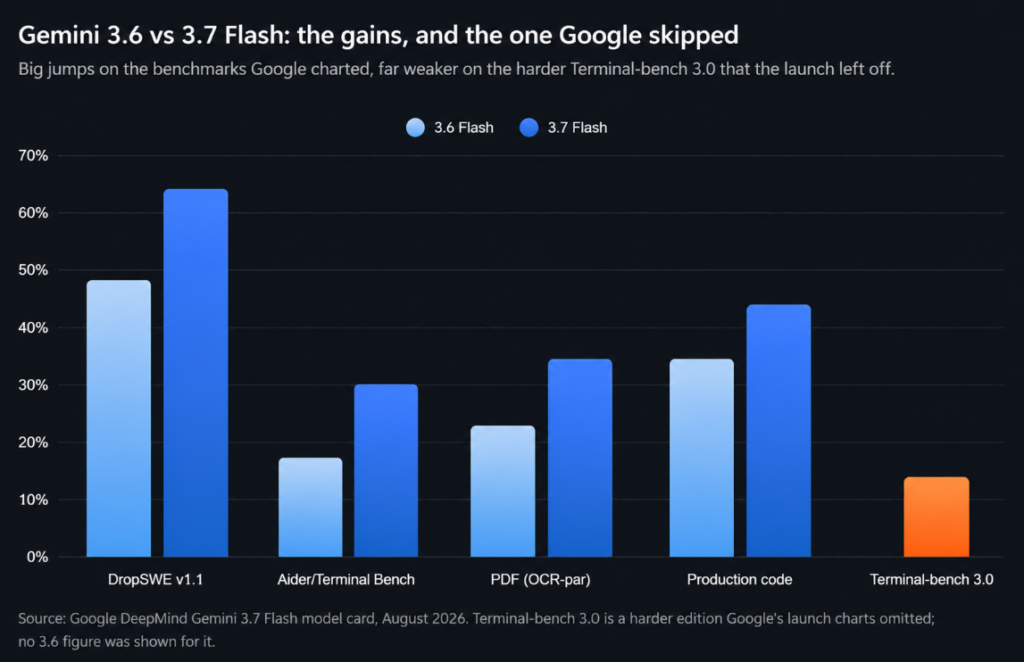
AutomationBench nearly doubling and DeepSWE jumping sixteen points is a genuine generational leap for a three-week gap. If your work is coding or agent automation, this is a real upgrade.
Now the part Google’s charts skip. On the harder Terminal-bench 3.0, 3.7 Flash scores 14.9%. That’s the same model, a different and tougher edition of a terminal task, and it’s a useful reminder that a benchmark number means little without knowing which edition is quoted. A launch chart showing 30.4% and a real-world task scoring 14.9% are both “true”, and only one made the slides.
The other thing the charts flatten: against competitors, the race is closer than the Gemini-versus-Gemini jumps suggest. On production code quality, 3.7 Flash scores 43.6% while Claude Sonnet 5 scores 42.7%. On web development Elo, it’s 1588 to Claude’s 1541. Those are wins, but narrow ones, not the runaway the big blue bars imply. Google chose to chart the benchmarks where the margin looks largest, which is exactly what you’d expect and exactly why you read past the launch post.
The Pricing, and the Date in Your Calendar
This is the genuinely aggressive part, and there’s a catch worth writing down.
| Input / 1M tokens | Output / 1M tokens | |
|---|---|---|
| Now, through 31 Dec 2026 | $0.75 | $3.75 |
| From 1 Jan 2027 | $1.50 | $7.50 |
The launch price is half what 3.6 Flash launched at. But that $0.75 is an introductory rate that expires on 31 December 2026, and on 1 January 2027 it doubles. If you’re budgeting a project around this model, the price you’re quoting today is not the price you’ll pay in the new year. Context caching doubles at the same time too.
One catch that hits harder than the list price: output charges include thinking tokens. Gemini 3.7 Flash reasons before it answers, and that reasoning counts as output. The model takes low, medium and high thinking levels and defaults to medium, so a task left on default can cost far more than the headline rate suggests. On simple extraction jobs, turning thinking down is the difference between a cheap call and an expensive one.
This is the same lesson we went through with Claude’s plans in Claude Pro vs Max: the sticker price is rarely the number that decides your actual bill.
The Release Nobody at Google Is Talking About
Here’s the context that reframes the whole launch, and it’s absent from Google’s announcement for an obvious reason.
Gemini 3.5 Pro, the flagship, still hasn’t shipped. It was announced at Google I/O in May 2026 for release the following month. That release never came, and Google has given no new date, including alongside this Flash launch. Reuters and Bloomberg have both reported that coding performance is behind the delay.
So look at what’s happening. The flagship Pro model is stuck, and meanwhile the mid-tier Flash model is getting shipped on a three-week sprint cadence with big coding gains. The interesting engineering is landing in the workhorse tier because the tier above it isn’t ready.
That’s not a reason to avoid 3.7 Flash. It’s a very good model at a very low price. But the enthusiasm in the launch is partly compensating for the model that isn’t there, and it’s fair to read “our most intelligent workhorse model” in that light. The workhorse is carrying the show because the racehorse is still in the stable.
Where You Can Actually Use It
This is a developer and API model first, not a consumer chatbot upgrade. If you use the Gemini app, you’re not really the audience for this release.
Access is through the Gemini API, Google AI Studio, Android Studio, Google Antigravity for agent workflows, and Gemini Enterprise. Third-party aggregators carry it too. It’s generally available, not a preview, so it’s stable enough to build on.
If you only ever talk to Gemini through the phone app, the model behind your chats may update quietly, but you won’t be choosing 3.7 Flash by name or paying these token rates. This launch is aimed at people wiring the model into software.
Should You Switch From 3.6 Flash
If you already run 3.6 Flash in production, the answer isn’t an automatic yes, and Google’s own framing quietly admits why.
During the promotional period, Google has applied the same $0.75 / $3.75 rate to 3.6 Flash as well. So the switch isn’t about a cheaper list price right now, since both cost the same. It’s about whether 3.7 actually does your specific job better.
A few benchmarks are flat or slightly lower on 3.7, so it isn’t a universal win. The sensible path is a regression test: run your real workload through both, and compare not just accuracy but retries and repair time. A model that reasons more can still be cheaper overall if it fails less often, and more expensive if it burns thinking tokens on tasks that never needed them.
For a new project, start with 3.7 Flash. For an established 3.6 deployment that works, move only after a matched test shows it’s genuinely better on your tasks, not on Google’s charts.
The Bottom Line
Gemini 3.7 Flash is a strong, cheap, coding-focused model, and the benchmark gains over 3.6 are real where they count. For new coding and agent work at this price, it’s an easy model to recommend.
Just read it with clear eyes. The launch charts show the benchmarks where Google wins biggest and skip the harder editions where the numbers drop. The introductory price doubles on 1 January 2027. And the whole energetic release sits on top of a flagship Pro model that still hasn’t shipped. None of that makes 3.7 Flash a bad model. It makes the marketing around it worth reading slowly.
Prices, benchmarks and availability in AI move fast, so treat every number here as accurate at the time of writing and check the official model card before you build on it. For how this fits the broader race, we looked at Gemini’s scale in Gemini reaching a billion users.