The headline going round is that Claude now watermarks everything it writes. That word, everything, is doing a lot of work it can’t support. Anthropic’s own explanation of the feature says the opposite in several places, and the gap between the headline and the documentation is exactly what marketers need to understand before deciding this matters.
Here’s what actually changed, drawn from Anthropic’s own write-up rather than from the panic around it, and what it does and doesn’t mean if you use Claude for content.
What Actually Changed
Anthropic announced on 14 August 2026 that Claude models will produce watermarked text. The watermark is a statistical pattern woven into the model’s word choices. It’s invisible to a reader, adds no hidden characters, costs no extra tokens, and doesn’t slow the model down.
The way it works is worth understanding, because it explains every limitation that follows. When Claude writes, it constantly picks between words that would work equally well. Cold and overcast, cold and grey. Normally that choice is settled by a random number. Watermarking changes the source of that randomness to something derived from a secret key, so afterwards, someone holding the key can check whether the pattern of choices matches what Claude would produce. If it does, they can estimate the probability Claude was involved.
That’s the whole mechanism. It doesn’t change the meaning, it doesn’t push Claude toward stranger words, and Anthropic says internal testing found no impact on quality, creativity or readability.
Why “Everything” Is Wrong
This is the part most coverage skips, and it’s the part that matters most to you.
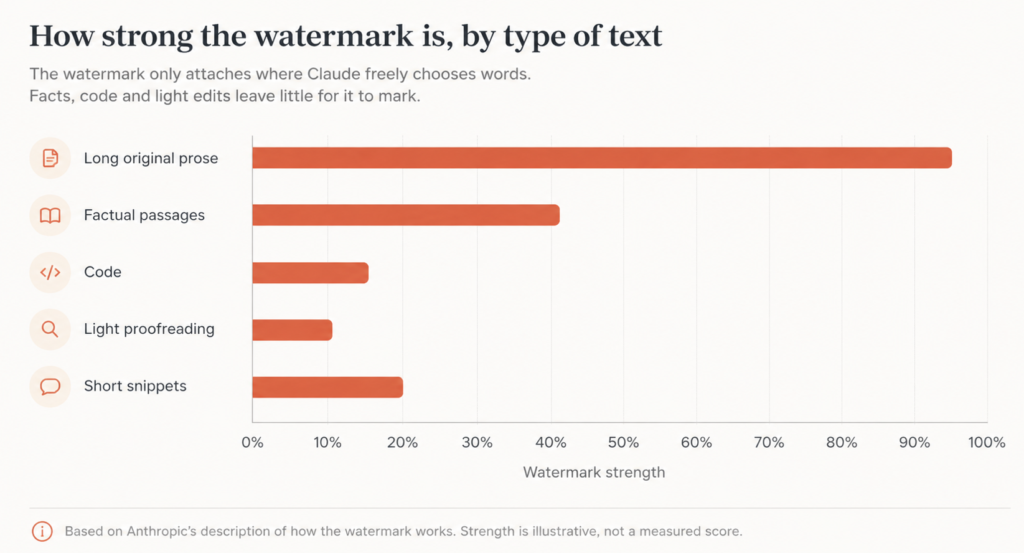
The watermark can only live in choices where more than one word would do. Where the text is pinned down, there’s nothing for it to attach to. Anthropic spells out several cases where the watermark is sparse or absent:
| Type of text | How much watermark |
|---|---|
| Long original prose | Strong. Many free choices to mark. |
| Factual passages | Sparse. Facts leave little room to vary wording. |
| Code | Minimal. Exact output required, so mostly unmarked. |
| Light proofreading of your text | Little to none. Few words are Claude’s. |
| Short snippets | Unreliable. Too little text to register. |
So “watermarks everything it writes” is false in a specific, checkable way. It watermarks the parts it freely composes, and the more it writes from scratch, the stronger the mark. Hand it a paragraph and ask only for grammar fixes, and there may be nothing detectable at all, because nearly every word is still yours.
That single fact reshapes how this affects a content workflow, which we’ll come back to.
This Isn’t Really About Claude
The framing that Anthropic decided to do this on its own is the second thing worth correcting.
Anthropic is doing this to comply with the EU AI Act. It signed the EU Code of Practice on Transparency of AI-Generated Content in July 2026, alongside around 190 other signatories including other major model providers. As of 2 August 2026, providers serving the EU market are required to mark AI-generated content.
In other words, the other large AI writing tools you might use are heading to the same place, under the same rule. Anthropic happened to publish a clear explanation and take the headlines. Treating this as a Claude-specific disadvantage misreads what’s happening. It’s an industry-wide legal requirement, and Claude is one of the first to document how it’s meeting it.
Anthropic also notes it’s applying the watermark globally at launch, not just in the EU, because it doesn’t yet have a reliable way to limit it by region. So this isn’t something you avoid by being outside Europe.
The Question Everyone’s Actually Asking: Will Google Penalise Me?
This is the fear driving most of the searches, so let’s take it apart properly.
A watermark is not an AI detector, and the difference is the whole answer. Detecting the watermark requires Anthropic’s secret key. Google doesn’t have that key. Nobody outside Anthropic does, until Anthropic releases the detection tool it says is still being built.
Anthropic draws this distinction directly. AI detection services like the ones marketers already worry about work by spotting stylistic tells in the writing. The watermark works by checking for a hidden statistical pattern with a key. They’re unrelated methods. Google reading your published page cannot check for Claude’s watermark, because Google isn’t holding Claude’s key.
More to the point, Google’s own position on this hasn’t changed and it predates the watermark. Google rewards helpful, reliable content regardless of how it’s produced, and acts against unhelpful content made at scale to game rankings, also regardless of how it’s produced. The watermark doesn’t add a new signal to that. Thin content was already a problem before August 2026, and good content was already fine.
So the honest answer: the watermark, on its own, gives Google nothing new to penalise you with. What can hurt you is the same thing that always could, which is publishing content that doesn’t deserve to rank.
What It Actually Proves, and Doesn’t
Even for whoever does hold the key, the watermark is a limited instrument, and Anthropic is unusually frank about its limits.
It can only tell you that Claude was likely involved at some point. It cannot separate “Claude wrote this” from “Claude heavily edited this”. It can’t tell you a human wrote something, and it can’t identify a different AI. It carries no information about who used Claude, which organisation, or which chat. And it works poorly on short passages, where there simply isn’t enough text to read a pattern from.
It also doesn’t change ownership or legal responsibility for the output. Anthropic states plainly that the watermark says nothing about authorship or rights, only about whether Claude was involved in producing the text.
And it can be removed. Light editing probably won’t strip it. A full rewrite where every word is replaced will, at which point, as Anthropic dryly notes, it’s debatable whether the text is still AI-generated at all.
What This Means for Your Workflow
Now the practical part. Given all of the above, here’s what genuinely changes for a marketer using Claude, and what doesn’t.
If you publish Claude’s output unedited, it’s detectable to whoever holds the key. Not to Google today, but to a future detection tool, and to any client or platform that runs your text through one once it exists. If your business model depends on passing AI writing off as hand-written, that model just got shakier.
If you use Claude as a drafting and editing partner, very little changes. The heavier your own hand in the final text, the weaker the watermark, by design. A piece you researched, restructured and rewrote in your own words carries far less of a signal than a prompt-and-publish job. This is the same direction good content practice already pointed.
Client work now has a paper trail. If you deliver content to clients as original writing, understand that a detection tool is coming, and that “Claude heavily edited this” and “Claude wrote this” look the same to it. Set expectations with clients now rather than being asked later. Being upfront about AI assistance is a better position than being caught by a tool you forgot existed.
Nothing about your costs or the tool’s behaviour changes. Same price, same speed, same output quality. You won’t notice the watermark in anything Claude gives you.
What About Images and Files
Text is only part of it. When Claude produces an image or a supported file, it attaches a content credential using C2PA, an open industry standard also used by camera makers and photo-editing software.
This is different from the text watermark and worth not confusing. It’s a signed note in the file’s metadata saying Claude was involved. Nothing in the image is altered, nothing is hidden in the pixels, and like the text watermark it carries no information about you. Any C2PA-aware tool can read it.
For marketers using AI images, this is the more immediately checkable of the two, because C2PA readers already exist, whereas the text detection API doesn’t yet.
The Honest Bottom Line
Strip away the headline and here’s what’s left.
Claude marks the text it freely writes, not everything, and least of all on facts, code and light edits. It’s doing so to meet an EU law that applies across the industry, not as a solo move. The watermark isn’t an AI detector and gives Google nothing new, so the ranking panic is misdirected. It proves only that Claude was probably involved, can’t tell writing from editing, and can be rewritten away.
What it really does is close the gap between “AI wrote this” and “nobody can tell”. For marketers whose work already adds something on top of the model, that gap closing costs nothing. For anyone relying on undetectable AI output as the whole product, it’s a warning that the ground is moving, and it will move the same way under every major AI tool, not just this one.
This is a fast-moving topic and some details, including the detection tool and how the EU rules are enforced, are still taking shape. Anthropic’s own explanation is the primary source and worth reading in full rather than relying on any single writer’s summary of it, this one included.