The number is real and the headline is fair: Google’s Gemini app crossed one billion monthly users on 11 August 2026, the fastest any product in the company’s history has reached that mark. What came next in most coverage, the line that Gemini has now caught or passed ChatGPT, is where the reporting quietly went wrong.
The two companies aren’t measuring the same thing, and once you see the gap, the more useful story isn’t the total at all. It’s buried in how those billion people actually use the app, and that part matters far more if you’re building anything that touches AI.
What Google Actually Announced
Sundar Pichai announced it on X on 11 August, and Google Labs VP Josh Woodward followed with a blog post breaking down the usage. Gemini became the 14th Google product to pass a billion users, joining Search, Gmail, Android, Maps, Chrome, Play and YouTube.
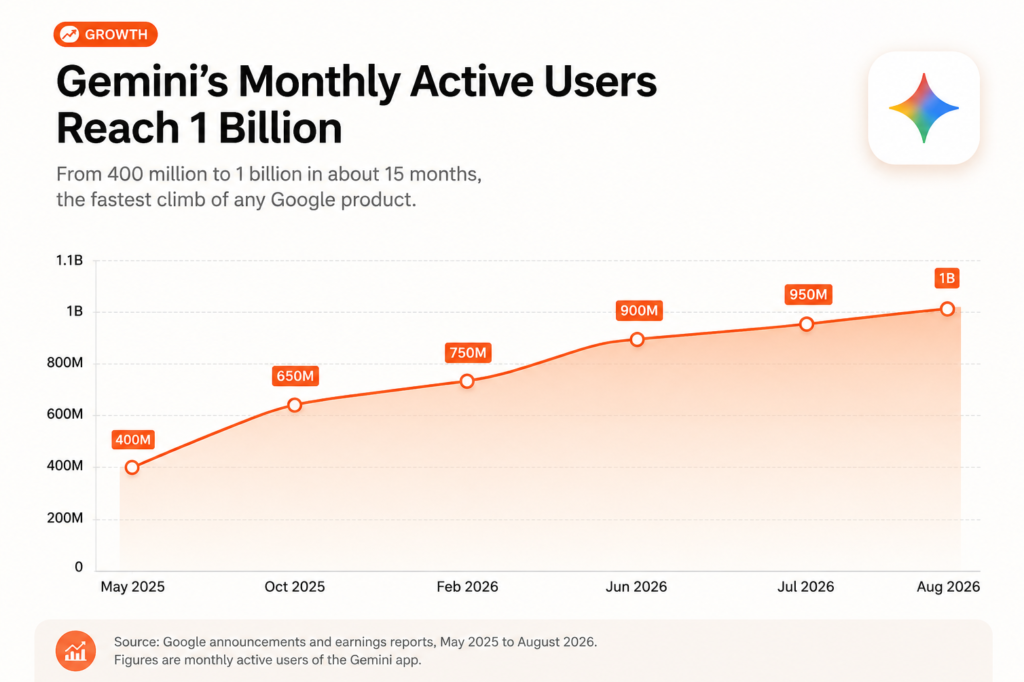
The climb over twelve months is genuinely steep. Google cited 400 million monthly users in May 2025, 650 million by October, 750 million in February 2026, 900 million at Google I/O, past 950 million in the July earnings report, then a billion about three weeks later.
| Date | Monthly users |
|---|---|
| May 2025 | 400 million |
| October 2025 | 650 million |
| February 2026 | 750 million |
| June 2026 (I/O) | 900 million |
| July 2026 | 950 million+ |
| 11 August 2026 | 1 billion |
For scale, Google noted that Gmail took roughly 14 years to build an audience that size. Gemini did it in well under two.
Why “Gemini Passed ChatGPT” Is Wrong
This is the part most coverage got backwards, and it’s worth getting right before you draw any conclusion from the number.
Google reported one billion monthly active users. That’s people who opened the app at least once in a month. OpenAI’s most-quoted figure is one billion weekly active users, confirmed on 6 August. A weekly billion is a much harder bar than a monthly one, because it counts only people coming back every seven days.
Line them up properly and the picture changes:
| 1B monthly | 1B weekly | |
|---|---|---|
| ChatGPT | May 2026 | July 2026 |
| Gemini | August 2026 | Not yet reported |
ChatGPT cleared the monthly billion three months earlier, and cleared the harder weekly billion a month before Google’s announcement. So Gemini reaching a monthly billion isn’t parity, and it certainly isn’t overtaking. Comparing a monthly number to a weekly one is the reporting mistake that produced most of the “Gemini wins” headlines.
None of that shrinks the achievement. Reaching a monthly billion this fast is real. It just isn’t the head-to-head victory it was dressed up as, and anyone making decisions off “Gemini is now bigger” is working from a false premise.
The Distribution Advantage Nobody Mentions
There’s a second piece of context that changes how you read the speed record.
Gemini comes pre-installed on Android, which Google owns. Google said more than 100 million of the billion are on Apple devices, which by implication means the large majority are on Android, where the app is already there before anyone chooses it.
ChatGPT reached its numbers as a download people actively sought out, with no operating system pushing it onto the home screen. That’s a different kind of growth. One is a company distributing a product across a platform it controls, the other is organic pull.
Neither is illegitimate. A user is a user. But “fastest to a billion” reads differently when the app ships on two billion phones by default, and leaving that out flatters the number. It’s the same reason a pre-installed app always has a head start, and it’s worth holding in mind rather than taking the race at face value.
The Number That Actually Matters
Here’s the figure almost every article buried, and the one with real consequences if you build anything that touches AI.
According to Google’s own data, 63% of Gemini users interact by voice rather than typing, with a growing group of “voice only” users who never type at all. Attachments and camera sharing are increasingly the default too, through the real-time Gemini Live mode.
Sit with that for a second. Nearly two thirds of a billion people are talking to their AI, not typing at it. If your mental model of AI use is a person at a keyboard entering a prompt, that model already describes a minority of what’s happening on the biggest platforms.
For anyone doing content or marketing, that has teeth. A voice query is phrased differently from a typed one, longer, more conversational, more like a spoken question than a string of keywords. The answer a voice user hears is often a single spoken response with no list of links to scroll. This is the same shift toward answers-without-clicks we went through in how Google search is becoming AI search, and voice pushes it further, because a spoken answer has even less room to send someone to your page.
What Google Left Out
A billion is a headline number. The number Google didn’t put in the headline tells you about the business underneath.
Google didn’t disclose how many of the billion pay for a subscription. Independent analysis has estimated somewhere around 15 to 25 million paying users earlier in 2026, which would be a low single-digit conversion rate. Google reported roughly $1.2 billion in Gemini subscription revenue for all of 2025.
That’s not a weakness so much as a different strategy. Google doesn’t need Gemini subscriptions to pay off directly, because its model is to monetise AI through advertising and Google Cloud, and to keep people inside the Google ecosystem. OpenAI, without a search-ads business or an operating system, leans much harder on subscriptions and API revenue. Two companies, two ways of turning users into money, and the raw user count hides that completely.
Why the Timing Wasn’t an Accident
The announcement landed the day before Google’s Made by Google hardware event, where the Pixel 11 was expected with deeper Gemini integration.
That’s not a coincidence. A billion-user milestone the day before a phone launch built entirely around your AI assistant is a set-up, and it’s worth reading the number partly as marketing. It’s real, but it was timed to do work.
OpenAI, by contrast, mentioned its own billion almost in passing, as a subordinate clause in a usage-data blog post. Two companies at similar scale, announcing in completely opposite registers. One made an event of it, the other buried it. That contrast tells you as much about their positions as the numbers do.
What This Means for You
Cutting through the milestone noise, here’s what actually changes for a small brand or publisher.
AI assistants are now genuinely mass-market. Two products at a billion users each means this isn’t an early-adopter behaviour any more. The people reading your content increasingly ask an assistant first and visit sites second.
Voice changes the questions being asked. If a large share of AI interaction is spoken, the phrasing people use is conversational and long. Content that answers a real spoken question directly has a better chance of being the answer an assistant reads out.
Being the cited source matters more than ranking. Whether it’s Gemini or ChatGPT, the pattern is the same: the assistant answers, and maybe names a source. Getting named is the new visibility, a point we went into properly alongside the watermark question in what AI content marking means for marketers.
Don’t pick a winner yet. The user counts are close, measured differently, and moving every quarter. Building your whole approach around whichever tool is “ahead” this month is a good way to be wrong next month.
The Bottom Line
Gemini hitting a billion monthly users is a real milestone and a real shift in the landscape. It is not Gemini passing ChatGPT, because a monthly billion and a weekly billion aren’t the same measurement, and ChatGPT cleared both bars first.
The more durable takeaway isn’t the scoreboard at all. It’s that AI assistants are now used at the scale of the biggest platforms on earth, that most of that use is by voice, and that the way people find information is changing underneath everyone building for the web. That’s the thing to plan around, not which logo got to ten digits first.
These figures come from Google’s and OpenAI’s own announcements in August 2026, and companies define and revise active-user metrics differently, so treat any single number as a snapshot. If you want the fuller picture of how all this reshapes search, we covered it in Google search becoming AI search.